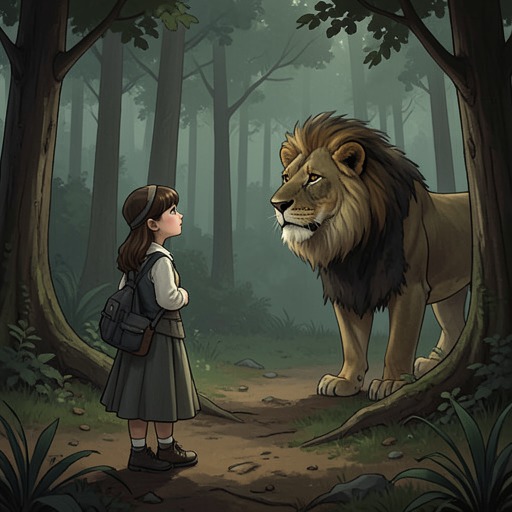
Lucy–Aslan relationship
The Last BattleLucy’s relationship with Aslan is a bond of trust that does not require her to deny sorrow or understand every turn in his purpose. At the end of Narnia, she grieves for the world she loves even while Aslan leads her onward; his final assurance answers her fear of separation by revealing that death is not an expulsion but the beginning of a more enduring story.
Trust Amid Uncertainty
Lucy’s faith takes shape against a history of departures. When she fears that Aslan may send her and the others back to their own world, she explains that he has done so before. Her anxiety is not a rejection of him: it arises precisely because the relationship matters, and because earlier returns have made separation seem possible again. Aslan answers her fear directly, telling her there is no danger of that fate and asking whether she has guessed what has happened.
The exchange follows an intimate moment of reassurance. Aslan observes that the children do not yet look as happy as he intends them to be; Lucy then gives voice to the fear beneath their unease. Rather than dismissing it, he responds with a promise and a disclosure. The scene makes trust reciprocal in form: Lucy can speak honestly about her fear, and Aslan meets it with the truth she needs.
Faith and the Right to Mourn
Lucy’s trust does not make her indifferent to loss. After Aslan calls the stars home and the old Narnia is brought to its end, Peter remarks that night has fallen, and asks why Lucy is not crying. She answers that Aslan would not want him to stop her: mourning for Narnia is not wrong. Her attention remains with what has died and frozen behind the Door, even as Aslan waits ahead.
That answer distinguishes faith from emotional denial. Lucy does not treat the world's destruction as harmless simply because Aslan is present, nor does she interpret grief as disloyalty. The old world is truly lost, and her sorrow gives that loss its due. As she and the others walk away from the Door, their mourning sits alongside their continuing trust rather than cancelling it.
Tirian gives public voice to the same conviction, saying that the women are right to weep and that he weeps too. He has seen his mother's death, and Narnia is the only world he has known; to refuse mourning would be discourteous. Lucy's words thus belong to a shared response, but remain characteristically direct: she asserts that Aslan does not forbid grief, while honoring the dead country she loved.
The End of Narnia and Aslan's Promise
The farewell is not a vague change of mood but a sequence of final acts. Aslan raises his head at the Door and roars that it is time; the Door flies open. The stars fall from the sky because Aslan has called them home. Later, after the sun has grown dark and unnaturally large, Aslan gives the command to make an end, and the Time-giant squeezes the sun until total darkness falls. Narnia's ending is complete, not an interruption from which Lucy expects the familiar country to recover.
That finality gives Lucy's mourning its force. She had hoped Narnia might go on for ever, though she knew her own world could not. Her words acknowledge an expectation that the story then overturns: Narnia, too, has reached its end. Aslan's presence does not reverse the destruction or erase the life that lies behind the Door; it changes the meaning of what comes after.
When Lucy asks whether they are afraid of being sent away, Aslan tells her there is no fear of that. He then explains that a real railway accident has taken the lives of her father, mother, and the others, and frames the transition as the end of term and the beginning of the holidays, the ending of a dream and the arrival of morning. The news is grave, but his explanation answers the question that has haunted her: this time, she is not being returned to a lesser, separate life.
Grief, Hope, and the Great Story
Aslan's assurance does not ask Lucy to pretend that Narnia never mattered. The narrative lets the children mourn its frozen end, remember its kings and wars, and leave the Dwarfs behind in the Stable they imagine themselves still inhabiting. Their movement onward preserves both sides of the relationship: Lucy can follow Aslan while remaining faithful to the world she has lost.
The ending makes that movement larger than a return to old adventures. Aslan no longer looks like a lion, and the narrator says that what follows is too great and beautiful to write. The children's life in their own world and their adventures in Narnia are described as only the cover and title page; the real story is beginning, and it goes on for ever, each chapter better than the last. For Lucy, trust reaches its fullest expression not in certainty about what Narnia would become, but in following Aslan through its ending into a reality he promises will not end.